How AI Music Detection Actually Works
A transparent look at the ISMIR 2025 neural vocoder fakeprint math, 8,192-point FFT pipeline, held-out benchmarks, and honest accuracy boundaries.
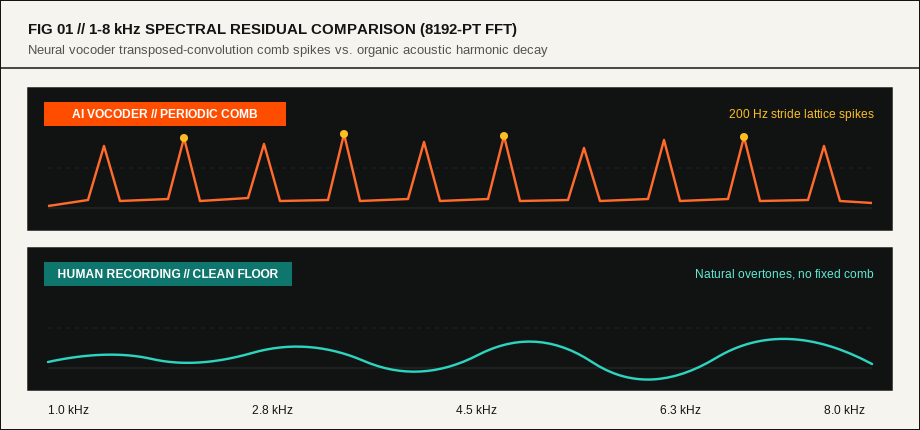
The Physics Behind AI Song Detection
Most listeners try to guess whether a track is AI-generated by listening to lyrics, melody clichés, or vocal polish. While human ears catch obvious mistakes, modern generative platforms like Suno and Udio now produce convincing guitar strums, drum grooves, and studio-grade mixes.
Instead of judging musical taste, IsThisSong.ai inspects the underlying signal physics left behind by neural audio decoders. This approach is grounded in the ISMIR 2025 Best Paper, "A Fourier Explanation of AI-Music Artifacts" (Afchar, Meseguer-Brocal, Akesbi, & Hennequin, arXiv:2506.19108).
What Is a Neural Vocoder Fakeprint?
Generative music models do not synthesize raw 44.1 kHz audio sample-by-sample directly from text prompts. Instead, they generate compressed neural tokens at a much lower frame rate and pass them through a neural vocoder (built with transposed-convolution / deconvolution upsampling layers) to reconstruct the full audio waveform.
That upsampling math introduces microscopic, regularly spaced energy peaks across the frequency spectrum—typically locked to integer multiples of the codec stride rate across 1 kHz to 8 kHz. In isolation these peaks are far too quiet to notice consciously, but when averaged across an entire song in the frequency domain, they form a sharp comb-like signature known as a vocoder fakeprint.
Exact 4-Stage Browser Pipeline
Every scan you run on IsThisSong.ai executes four deterministic DSP steps strictly inside your browser's memory:
- Local Audio & Video Decoding: Your browser's Web Audio API decodes standard audio formats (MP3, WAV, M4A, FLAC, OGG) as well as audio tracks embedded inside MP4, MOV, and WebM video clips.
- Bandwidth Integrity Check & 16 kHz Resampling: Before downsampling, we inspect the native sample rate and effective high-frequency cutoff so we can flag heavily compressed rips (<11.5 kHz ceiling). We then downmix to mono and resample to 16,000 Hz (up to 300 seconds).
- 8,192-Point STFT & Lower-Hull Residual: We apply a periodic Hann window with 50% overlap (hop size 4,096), compute the log-power spectrum averaged across frames, slice the 1,000 Hz – 8,000 Hz band (3,585 frequency bins), and subtract a 10-bin sliding lower envelope (
min_dB = -45). Clipping the residual at5 dBand max-normalizing isolates narrow vocoder spikes from normal musical harmony. - 3,585-Bin Classification & Window Timeline: A trained logistic regression classifier scores both the full-track fakeprint and individual ~10-second windows, returning an overall probability alongside a clickable segment timeline.
Held-Out Benchmark Performance
Our browser engine runs the open-source MIT-licensed weights from lofcz/ai-music-detector, trained on 89,329 tracks (60,625 synthetic tracks from SONICS & proprietary Suno/Udio sets plus 28,704 real recordings including FMA Medium) and evaluated on 17,866 held-out test tracks:
| Benchmark Metric | Held-Out Test Result (n = 17,866) |
|---|---|
| Overall Accuracy | 99.88% |
| Precision | 99.85% |
| Recall (True Positive Rate) | 99.98% |
| F1 Score | 99.91% |
| False Positive Rate (Real flagged as AI) | 0.31% |
| False Negative Rate (AI missed) | 0.02% |
Known Limitations & Honest Boundaries
Real-world audio is messier than clean benchmark datasets. To stay transparent, IsThisSong.ai always reports probabilistic categories (Likely AI-Generated, Mixed / Uncertain, or No AI Artifacts Detected) and warns you when conditions lower confidence:
- Severe Lossy Compression: Re-encoding an audio track multiple times at low bitrates (for example, 64–96 kbps social rips or phone microphone recordings) smears narrow spectral peaks in the 4–8 kHz region.
- Heavy Post-Processing & Hybrid Tracks: If a creator generates a Suno track, separates stems, replaces the vocals with a real singer, and runs heavy analog tape saturation or pitch shifting, vocoder peaks weaken and scores may fall into the Mixed range.
- Short Audio Clips: Clips shorter than 8–10 seconds have fewer STFT frames to average out musical transients, making residual estimates noisier.
- Future Unseen Vocoders: Whenever AI music platforms release fundamentally new decoder architectures, fakeprint weights must be retrained on fresh samples.
For playlist curators, music journalists, and commercial buyers, treat spectral analysis as a fast forensic radar: flag high-probability tracks immediately, then verify contested submissions with original DAW stems.
Because both human ears and pure spectral models have blind spots, the most reliable workflow is cross-checking them together: pair our local FFT scan with our practical guide on how to tell if a song is AI, or review common compression and hybrid-track edge cases in the FAQ.
Run a Live Spectral Audit
Load any MP3, WAV, M4A, or video clip into the browser deck for an instant 1–8 kHz readout.
OPEN AI SONG DETECTOR